Prediction Markets Arbitrage: How to Profit When Polymarket and Kalshi Disagree
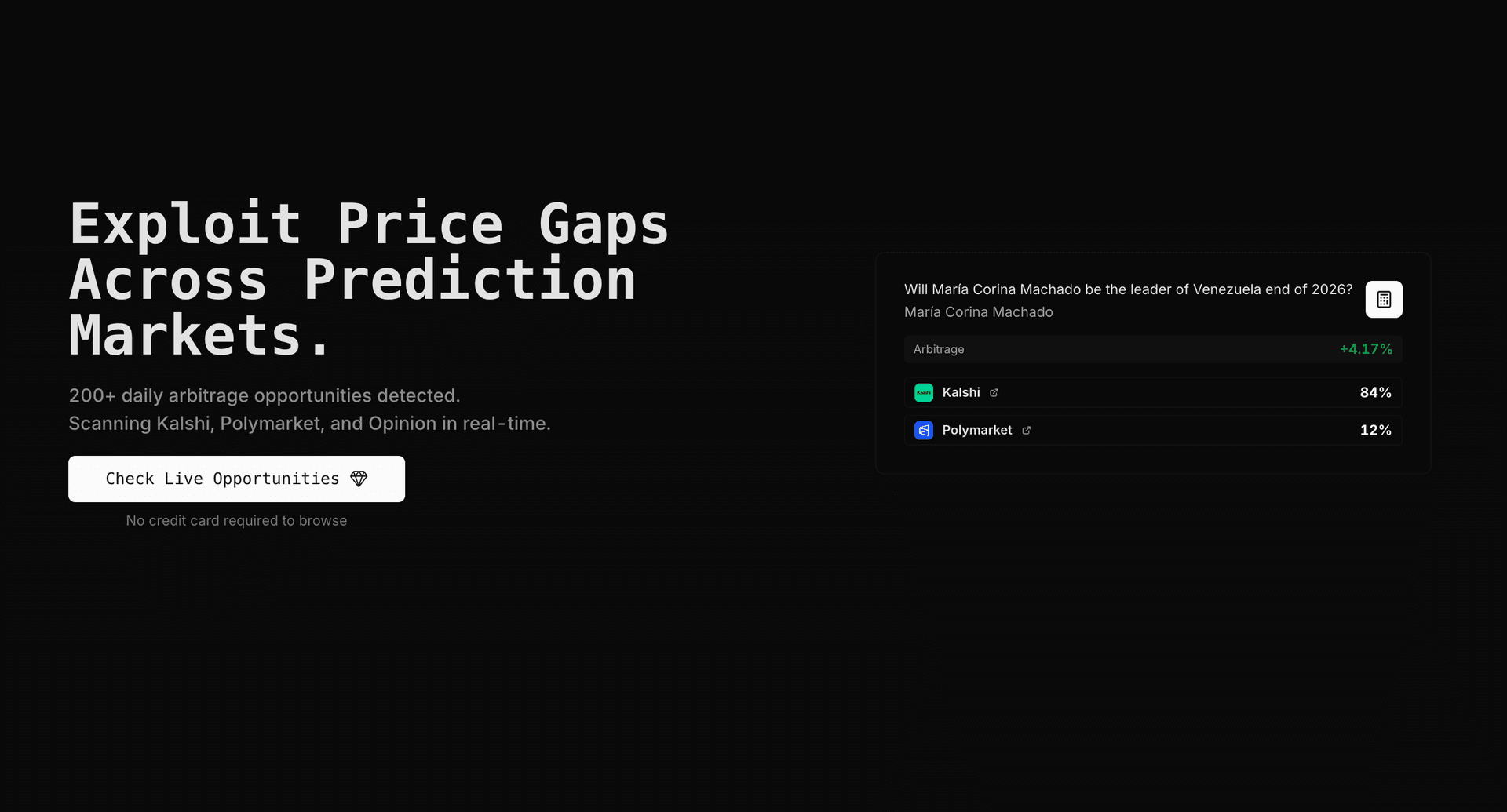
Find prediction market arbitrage opportunities in real-time with ArbBets. We scan Polymarket, Kalshi, and Opinion to find 100+ profitable opportunities daily.
TL;DR
Prediction Markets Arbitrage: How to Profit When Polymarket and Kalshi Disagree
Polymarket and Kalshi price the same events differently. Sometimes by a lot. When one platform says an event has a 62% chance of happening and the other says 55%, that gap is your profit margin.
This is prediction markets arbitrage: trading both sides of the same event across platforms to lock in a mathematically guaranteed return, regardless of the outcome.
Here's how it works, why these price differences exist, and how to find them before they disappear.
What Is Prediction Markets Arbitrage?
Prediction markets arbitrage is the practice of buying contracts on the same event across two or more platforms when their prices don't add up correctly. If the combined cost of covering all outcomes is less than the guaranteed payout, the difference is your profit.
Unlike sports betting or speculative trading, arbitrage doesn't require you to be right about what happens. You profit either way. The math guarantees it.
Quick example: If Polymarket prices "Will X happen?" at $0.58 YES, and Kalshi prices the same event at $0.38 NO (implying $0.62 YES), there's a 4-cent spread. Buy YES on Polymarket at $0.58 and NO on Kalshi at $0.38. Your total cost is $0.96. One side pays out $1.00, guaranteed. That's a 4.17% return on a single trade.
Why Do Polymarket and Kalshi Price Events Differently?
These two platforms operate on different infrastructure, attract different traders, and process information at different speeds. The result: prices diverge constantly.
Different trading mechanics. Polymarket runs on a Central Limit Order Book (CLOB) built on Polygon. Traders place limit and market orders, and prices reflect the order flow of crypto-native users. Kalshi is a CFTC-regulated exchange with its own matching engine. Different participants, different order flow, different prices.
Different user bases. Polymarket skews toward crypto traders and international participants. Kalshi attracts more traditional finance types and U.S.-based traders. These groups interpret news differently and react at different speeds.
Liquidity gaps. A market might be deep and active on Polymarket but thinly traded on Kalshi, or the other way around. Low liquidity means prices can sit at stale levels longer, creating wider spreads.
Regulatory differences. Kalshi is CFTC-regulated and occasionally restricted from listing certain markets. Polymarket, operating offshore, lists more aggressively. When both cover the same event, their regulatory constraints can influence pricing.
Information asymmetry. News breaks and one platform reacts faster than the other. A tweet, a poll result, a policy announcement. The platform with more active traders adjusts first. The other lags. That lag is your window.
How Polymarket vs Kalshi Arbitrage Works (Step by Step)
Here's the actual process for executing a cross-platform arb between Polymarket and Kalshi.
-
Find a matching event. Both platforms need to cover the same event with the same resolution criteria. "Will the Fed cut rates in March 2026?" on both platforms, resolving on the same date, with the same conditions. Mismatched resolution criteria will burn you.
-
Compare real prices. Check the actual orderbook on each platform, not just the displayed mid-market price. The number that matters is what you can actually fill at. A contract showing $0.55 might only have $200 of liquidity at that price. If you need to fill $2,000, your effective price could be $0.57 or worse.
-
Calculate the arb. Add your YES cost on one platform to your NO cost on the other. If the total is below $1.00 (minus fees), you have an arb. The formula:
Arb % = (1 - YES cost - NO cost) / (YES cost + NO cost) x 100
Account for trading fees on both platforms. Polymarket charges no trading fees but has gas costs. Kalshi charges fees per contract.
-
Execute both sides simultaneously. Speed matters. Place both orders as close together as possible. If you buy YES on Polymarket and the Kalshi price moves before you buy NO, your arb can shrink or vanish.
-
Wait for resolution. One side wins, one side loses. The winning side pays $1.00 per contract. Your profit is $1.00 minus your total cost across both platforms.
A Real-World Arbitrage Example
Say both Polymarket and Kalshi are running a market on whether a specific bill passes the Senate by June 2026.
| Polymarket | Kalshi | |
|---|---|---|
| YES price | $0.52 | $0.58 |
| NO price | $0.48 | $0.42 |
You spot that Polymarket YES ($0.52) + Kalshi NO ($0.42) = $0.94.
You buy 100 YES contracts on Polymarket for $52 and 100 NO contracts on Kalshi for $42. Total outlay: $94.
- If the bill passes: Your Polymarket YES pays $100. Kalshi NO pays $0. Profit: $6.
- If the bill fails: Your Polymarket YES pays $0. Kalshi NO pays $100. Profit: $6.
Either way, you make $6 on $94 invested. That's a 6.38% return with zero directional risk.
What Makes a Good Arb (and What to Watch Out For)
Not every price difference is a real opportunity. Here's what separates profitable arbs from traps.
Check resolution criteria carefully. Polymarket and Kalshi sometimes word their markets differently. "Will inflation fall below 3%?" might use different CPI reports, different dates, or different rounding rules on each platform. If the resolution criteria don't match exactly, you're not hedged. You're just making two separate bets.
Account for all costs. Fees, gas costs, withdrawal fees, and the opportunity cost of capital locked in contracts that might not resolve for months. A 2% arb that ties up your money for 90 days is very different from a 2% arb that resolves next week.
Watch for liquidity. The prices you see on the surface aren't always the prices you get. Check the orderbook depth. If there are only $50 worth of contracts at the price you want, scaling up won't work without moving the market against you.
Consider settlement time. After a market resolves, it can take hours or days to get your funds back. On Polymarket, you need to withdraw USDC to your wallet. On Kalshi, payouts hit your account balance and can be withdrawn to your bank. Factor this into your capital planning.
How ArbBets Finds These Opportunities
Scanning Polymarket and Kalshi manually is possible but slow. By the time you compare prices, check resolution criteria, calculate the arb, and confirm orderbook depth on both platforms, the opportunity is often gone. Spreads that last minutes on screen may only be executable for seconds.
ArbBets scans both platforms in real time, pulling live orderbook data (not just mid-market quotes) to calculate arbs based on prices you can actually fill. The difference between mid-market and executable prices matters. A spread that looks like 5% on the surface might only be 2% when you account for the actual liquidity available at each price level. Browse current Kalshi ↔ Polymarket spreads on the free Kalshi Polymarket arbitrage finder — no login required.
We surface 100+ arbitrage opportunities daily between Polymarket, Kalshi, and Opinion.
For developers building automated systems, our API delivers normalized data from all three platforms through a single endpoint. No need to integrate each exchange separately.
Frequently Asked Questions
How much money do you need to start arbitrage trading on prediction markets?
Most traders start with $2,000-$5,000 spread across Polymarket and Kalshi. You need capital on both platforms to execute both sides of an arb quickly. Smaller amounts work but limit the number of opportunities you can take since some require minimum order sizes to be worth the fees.
Is prediction markets arbitrage legal?
Arbitrage trading is legal. Kalshi is CFTC-regulated and available to U.S. residents. Polymarket operates offshore and has restrictions for U.S. users. Check the terms of service for each platform and consult a tax professional about reporting requirements, since gains from prediction market trading are taxable income.
How long do arbitrage opportunities last between Polymarket and Kalshi?
Most arbs last seconds to minutes. High-value spreads (above 3-4%) close fastest because more traders are watching for them. Smaller spreads (1-2%) can persist longer but require more capital to be worthwhile. Automated tools detect opportunities faster than manual scanning.
What's the average return on prediction market arbitrage?
Returns vary by opportunity, with most falling in the 1-8% range. The key is frequency: with 100+ opportunities surfacing daily, consistent execution compounds returns over time.
What are the risks of prediction markets arbitrage?
Arbitrage reduces directional risk (you profit regardless of the outcome) but doesn't eliminate all risk. Key risks include: mismatched resolution criteria between platforms, liquidity risk (prices moving before you execute both sides), platform risk (exchange downtime or withdrawal issues), and capital lockup (funds tied to contracts until resolution). Carefully matching resolution criteria and using real-time orderbook data mitigates the biggest risks.
Ready to profit from prediction market arbitrage? Try ArbBets and start finding opportunities across Polymarket, Kalshi, and Opinion today.